The Holder of this blog uses no cookies and collects no data whatsoever. He is only a guest on the Blogger platform. He has made no agreements concerning third party data collection and is not provided the opportunity to know the data collection policies of any of the standard blogging applications associated with the host platform. For information regarding the data collection policies of Facebook applications used on this blog contact Facebook. For information about the practices regarding data collection on the part of the owner of the Blogger platform contact Google Blogger.
Showing posts with label Book Reviews. Show all posts

Friday, September 30, 2005

A Word Association Test.

by Gilbert Wesley Purdy

Words Brushed by Music ed. by John T. Irwin.
Baltimore, MD: Johns Hopkins University Press, 2004.
200 pp. $12.95 paper. ISBN 0-8018-8029-7. $27.50
hardcover. ISBN 0-8018-8028-9.


In 1979, while the poetry world as a whole was marching with ever greater determination towards quote-unquote free verse and one or another variation of anti-poetry, Johns Hopkins University Press staked out its own territory. Its new Poetry Series would provide a haven for poets who had chosen to write the only truly alternative poetry that remained: a poetry which stayed connected to the tradition of the craft.... [Go to the review>>>][Go to the Book Review Index>>>]

Saturday, September 24, 2005

Dueling Mythologies.

by Gilbert Wesley Purdy.

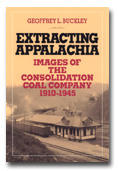
Extracting Appalachia: Images of the Consolidation Coal Company 1910-1945 by Geoffrey L. Buckley.
Athens, Ohio: Ohio University Press, 2004. xxiv+216 pp.
$46.95 cloth. ISBN 0-8214-1555-7. $22.95 paper. ISBN 0-8214-1556-5.


In the process of working toward his doctorate, in Geography, Dr. Geoffrey L. Buckley informs us, it was his “good fortune to stumble upon a truly remarkable collection of coal-mining photographs.” The photographs — some four thousand in all — were taken for the Consolidation Coal Company, the largest of the various consolidated mining interests in the Mid-Atlantic region of the United States. That collection is the subject of Extracting Appalachia: Images of the Consolidation Coal Company 1910-1945. Various historical studies and the Consolidation Coal Company Mutual Monthly, the company organ in which many of the photos appeared, provide the immediate context from which it is viewed.

Buckley is not unaware of the validity of the analytical/semiotic perspective. The reader is warned that photographs are not the purely objective records they may seem to be. The author defers to Mona Domosh, a colleague in his field of Historical Geography:


Visual material — photographs, advertisements, and newspaper images — are discursive forms, and need to be interpreted as documents of culture, or as “texts.” These images are not transparent conveyors of “truth,” but instead participate in the creation of meaning.

All reference to the need for a rigorous analytical machinery, however, remains in a chapter set aside for the purpose of making general observations relating to the matter. The pictures themselves are queried almost entirely from an historical perspective.

The fact that historical perspectives can be highly problematical has earlier been made clear, in the Introduction, by dint of a prophylactic statement:


My purpose here is not to write yet another history of coal mining in Appalachia. That task has been carried out ably by others. Nor is it my intention to excoriate the coal industry for its poor safety record, its abuse of individual liberties, its antiunionism, and its use of heavy handed tactics during the first three decades of the twentieth century. No doubt these are valid criticisms, even if sometimes we have carried the generalizations too far…. Rather, my purpose is to critically examine the photographs in the Consolidation Coal collection, place them in historical context, and try to understand why they were taken and for whom.

The presence of such a disclaimer suggests a wider context within which Extracting Appalachia resides, limitations under which its author necessarily labors. Any attempt at detachment will run the risk of appearing revisionist about historical matters which are resoundingly considered to be settled, and which, like all “resoundingly settled” historical matters, have for their proof a fierce emotional certainty. It is not the best environment for critical examination.

Nor does this fierce certainty exist only among the audience that Buckley imagines for his book. The above disclaimer is written for himself, as well. The detachment which he seeks — and within which he intends to examine the photographs — is every bit as much a myth as the prevailing history. There are few observations in this book that are not imbued with its author’s affinities. Those affinities are a product of the prevailing histories. His intention not to “excoriate” ends at just that. While he has sought to set aside the popular accusatory tone for a more muted one, his narrative is always mindful of his obligations.

To say that the claims of historical verity and scholarly detachment, which the reader is provided, are myths is, of course, not to suggest that they do not arrive at meaningful results. It merely describes how they arrive at their respective results. In the case of Extracting Appalachia, it also explains the limitations that Geoffrey L. Buckley has chosen — or felt compelled to choose — for his book.

Some ninety black and white photographs, chosen from the Consolidation collection, are reproduced as the subject of Dr. Buckley’s examination. The four photos in the first chapter — “Reading Historical Photographs” — are wide-angle shots intended to be representative of common themes in the collection and otherwise undergo no inspection. No photos appear in the second chapter, in which the reader is provided a brief, well turned historical overview of the mining of coal in the U. S. and the formation and rise of Consolidation Coal:

In 1927, Consolidation became the largest commercial producer of bituminous coal in the United States. In that year, the company operated ninety-two mines, employed over twelve thousand workers representing forty-three nationalities, and possessed an estimated 2.7 billion net tons of unmined mineral resources.

This ascent came by way of means that today might be considered questionable. In states such as West Virginia and Kentucky coal was king. Its representatives served as senators, congressman and governors, regularly voting the needs of their industry, it being, to their minds, synonymous with the needs of the citizens of the states they represented.


This foundation lain, the remaining four chapters are devoted to placing the photographs in socio-historical context. Coal company towns and their mines are shown in various stages of construction. In particular, the environment surrounding the miner’s life on the surface attracts Buckley’s attention. This environment necessarily includes the company magazine, the Consolidation Coal Company Mutual Monthly, from which extracts are freely quoted.

A great many observations are made upon the Mutual Monthly throughout Extracting Appalachia. The following, though more direct than most, may fairly be called “representative”:

In a very real sense, the photographs in the Consolidation Coal collection abetted the Employment Relationship Department’s efforts to achieve the company’s goals. When we gaze at rows of freshly painted company houses, merchandise at the company store, group photos of miners, and impressive gardens, we must ask ourselves why the company selected these images for publication in its magazine. We must recall that company towns were carefully planned places designed to maximize production and enhance surveillance. We must remember the company store’s reputation — deserved or not — for price gouging and debt peonage.

Nothing in the historical overview lays sufficient groundwork for these observations, and, as much as the reader may agree with many of the claims made here, the use of terms such as “abetted,” inferring that the company and its Employment Relationship Department were engaged in a quasi-criminal enterprise, is problematical. It is unclear why, in reference to these ninety photographs, we must remember the company store’s reputation “deserved or not”.

We may see these as — and they are represented as — attempts to counterbalance the company’s unquestionable intention to use the photographs to enhance its image with potential stockholders, government inspectors, its workers, the general public and itself. Hence the reader is presented with dueling mythologies: competing attempts to establish the real history of Consolidation Coal. In the words of Roland Barthes:


…what causes mythical speech to be uttered is perfectly explicit, but it is immediately frozen into something natural; it is not read as motive but as reason.1


Through the apparent transparency of the photograph, the company had sought to make its case. Its officers were subtle enough not to resort to obvious tactics. The photos are simple. Any arrangement — any posing — stayed well within recognized limits. Buckley utilizes prevailing historical perspective, lightly seasoned with observations garnered from the field of semiotic analysis, to combat one myth with another.

The company did use “selection” to an extent that may be considered indicative. Buckley’s argument to this affect is strong:

Comparing the pictures in the Consol collection with images taken by Farm Security Administration photographers, as well as those found in private collections such as the Mary Behner Christopher archive, we find sharp differences with respect to content. Unlike the Consol photographers, the FSA photographers show us the grim side of life in a coal-mining town — the unpaved streets, the poor condition of company housing, the inadequate facilities for drinking water and for waste disposal. The government photos, in particular, remind us that it was not uncommon to find children working in and around the mines. Government photographers also take us into the homes of the miners so that we can view the condition of company owned houses and gain valuable insights into the daily lives of the mining families.

Consolidation Coal clearly chose its model towns as the subjects of most of the ninety photos in Extracting Appalachia. Within the context of the historical period represented by the photos, its photographers chose, in them, subjects calculated to impress. Those photos that do seem uncomplimentary are generally of subjects that would have seemed favorable in the early twentieth century, impressed as it was with industrial scenes, and the wealth they implied, and unimpressed as it was with the natural environment, there seeming to be inexhaustible tracts of unspoiled land.

But it is important to recognize that Consolidation is not the only source of selectivity here. Buckley himself has selected these ninety photographs out of some 4000+. He, too, necessarily has an agenda to advance. The reader is provided no description of the 3910+ remaining photos. The Farm Security Administration selected its subjects in order, as Buckley himself points out, to support President Roosevelt’s New Deal programs. Furthermore, the FSA photographs Buckley describes were taken during the depths of the Great Depression, while all but a very few of the pictures he has selected from the Consolidation collection were taken during the boom years that preceded the Depression, the company magazine having ceased publication in 1928.

Moreover, the desegregation that existed only within the mines proper, correct as our author is to point out the hypocrisy of it, was more than was generally available elsewhere below the Mason-Dixon line (and in much of the North). The mines had already long provided a greatly improved lifestyle for Eastern European laborers — whose place had been taken by African-Americans due to reduced immigration, from that region, during World War I — and a ready route to assimilation. For all the problems that have historically inhabited company towns, the better Consolidation towns had postal, telephone and electrical service, well before they were generally available to the rest of the rural United States. The laborer for Consolidation Coal was not entirely naive when he thought that life was good.

Simplifying matters to the more direct question as to whether the photos are “untruthful,” we may begin, at least, to avail ourselves of the advantage of the more objective criterion of semiotic analysis. Those provided (however paratactically) by Winfried Noth, in “Can Pictures Lie?”, are simple and compelling:


The question of truth or lie in pictures has a semantic, a syntactic, and a pragmatic aspect. From a semantic point of view, a true picture must be one which corresponds to the facts it depicts. From a syntactic point of view, it must be one which represents an object and conveys a predication about this object, and from the pragmatic point of view there must be an intention to deceive on the part of the addresser of the pictorial message. 2

The transparency of the photograph stems from its perfectly satisfying the first criteria. The photographs in question employ various predicates, satisfying the second. As for the pragmatic aspect, there would seem to be no reason to believe that the management of Consolidation had undertaken a systematic program of disinformation. It is arguable, in view of these ninety photos, that the collection may simply reflect the normal social constructs and exigencies of the times.

Geoffrey L. Buckley would presumably reply that the conditions in these towns were an exception rather than the rule, that both the model towns and photos were predicated upon the highest possible profit structure and the lowest possible wage structure. Even in photos of these models towns there are indications that problems abounded. At this point in our history, when unions are in retreat and ever larger portions of the U.S. population face low wage employment stripped of health and retirement benefits, when the concept of Affirmative Action is under attack, he might add, corporations can not be allowed to think that the convenient excuse of “the times” is available to them, that sophisticated public relations can expunge a multitude of sins. We all bear a responsibility to strive to overcome our “social constructs and exigencies” — particularly those of us who possess wealth and power.

The reader of Extracting Appalachia will find a book that walks the line between topical non-fiction and scholarship. Accordingly, no attempt is made to analyze the photographs as photographs. None to utilize them as a means to add to our knowledge of period or place. No higher level myth is sought from which to resolve the competing mythologies that inform the book and photos.

Dr. Buckley’s advocacy for the rank and file coal miners of the early twentieth century, and, by extension, the rank and file workers of all industries and periods, is laudable. Mythologies are not, it bears repeating, necessarily untrue. His intent, by however circuitous a process, is to place ninety photographs into an existing framework and to free them to say what they have to say within it. Toward the end that they may speak freely, within that framework, he has sought to avoid stridency and overt politicization. On that basis, it seems a fair surmise that Extracting Appalachia: Images of the Consolidated Coal Company will justly occupy an honored place within Geographical and Labor History collections.


1 Barthes, Roland. Mythologies, trans. Annette Lavers (New York: Noonday Press, 1975) 129.
2 Noth Winfried. "Can Pictures Lie?" Semiotic Review of Books, Vol. 6, No. 2 pp 10-12. Canada: University of Toronto, 1995. http://www.chass.utoronto.ca/epc/srb/srb/pictures.html.


Gilbert Wesley Purdy has published poetry, prose and translation in many journals, paper and electronic, including: Jacket Magazine, Poetry International (San Diego State University), The Georgia Review (University of Georgia), Grand Street, SLANT (University of Central Arkansas), Consciousness Literature and the Arts (University of Wales, Aberystwyth), Orbis (UK), Eclectica, and Valparaiso Poetry Review. Links to his work online and to a selected bibliography of his work in paper venues appear at his Hyperlinked Online Bibliography.

Monday, May 23, 2005

The Eye of the Beholder.

by Gilbert Wesley Purdy. eye: poems and retina prints by Elizabeth Goldring. Kansas City: BkMk Press, 2002. ISBN 1-886157-37-5. $15.95 Note: The links in this essay/review are designed to provide a slideshow to accompany the text. Elizabeth Goldring - the author of eye: poems and retina prints -- apparently began to lose her sight in the early 1980s. She is suffering from proliferative retinopathy - a disease restricted to diabetics. A lack of blood nutrients triggers a growth hormone, in some diabetics, causing new blood-vessels to grow in the retina of the eye. The vessels are improperly formed and eventually hemorrhage to fill the aqueous humor with blood. 

Before her blindness, she had been impressively working (and networking) her way along a career path in academia. From her beginnings as a baccalaureate from Smith College, and a public school teacher of French and art, she had rapidly achieved positions at the Field Museum of Natural History of Chicago, the Smithsonian Institute and the Children's Museum of Boston, and had become a fellow at the Center for Advanced Visual Studies at M.I.T. In amongst it all, she found the time to acquire a Masters, in Education, from Harvard. 

The Center for Advanced Visual Studies (CAVS, for short) is a remarkable place. Founded in 1967 by Gyorgy Kepes (whom Goldring cites as a profound influence on her work), it is dedicated to exploring the compatibility of science and art. The idea is to create art. The associated degree work is in science. 


Kepes came to America, in 1937, at the behest of Laszlo Moholy-Nagy. Moholy-Nagy had found the backers necessary to open the New Bauhaus in Chicago. In the words of Hilton Kramer:
The dream he harbored was for a kind of art that could not be contained by the easel, the studio, or the museum. Nowadays, I suppose, we would call it environmental art, though Moholy's dream cannot really be understood in purely aesthetic terms. What he envisioned was a grandiose form of social reconstruction - a benevolent revolution in which the resources of industrial technology would be used to liberate and elevate the sensibility of the masses. The role of the artistic impulse in such a revolution would not be to produce precious objects (such as easel paintings), but to redesign every object - indeed, every visual sensation - in the environment. Art would cease to be an end in itself and become a method - the primary method, in fact - for transforming society into a happier and more harmonious community.
Kepes was appointed Professor of Color and Light. He came into his own with the publication, in 1944, of his book Language of Vision. The work is considered something of a classic. 

Kepes was deeply interested in Kinetic Art composed of light, an early example of which was Nahum Gabo's 1920 light sculpture. Gabo had taken his bearings from Umberto Boccioni's continuity sculptures and Marcel Duchamps's "Nude Descending a Staircase," both of which had been influenced, in turn, by the tremendously exciting early experiments in the motion picture by the likes of Eadweard Muybridge. The studies had rapidly transformed the art world. 

Through CAVS, he would finally have the resources necessary for new experiments and larger works. It was Moholy's dream come true at a level that he could hardly have imagined: Bauhaus: the New Generation, as it were. The world's finest environmental and kinetic artists joined scientists and technicians there for a continual celebration of technology and light. While the utilitarian aspect was not lost sight of, CAVS was also influenced by prevailing theories of play. Aesthetics were encouraged. 


In 1974, Otto Piene - Kepes first choice for a CAVS fellowship, in 1968 -- took over as director. Elizabeth Goldring was named a fellow in 1975. The two collaborated with composer and light artist Paul Earls to create the tremendously successful "sky opera" Icarus. Piene created the Centerbeam: a 175 foot long construction of perforated pipes that continuously released a steam screen upon which light figures were projected in coordination with the story of the opera. Goldring's role seems mainly to have been as a project coordinator, of sorts. Both created the Sky Art conferences of the mid-80s. 

Elizabeth Goldring's eye: poems and retina prints is an example of how the spirit of the Bauhaus renews itself still. The idea of the prints began to take shape when her eye doctor first utilized a Scanning Laser Ophthalmoscope (SLO) to flash a picture past her hemorrhages and onto her retina. She saw a clear image for the first time in years. Soon she was familiar with the machine and intent to use it as an Internet reading device for those with limited vision. A new language would be necessary: a vocabulary of images. "For me," the author writes, "the Retina Prints are visual poems." 

Along the way, Goldring worked with Rob Smyser -- then manager of the M.I.T. Computer Resource Laboratory -- to do the initial interface of an SLO with the Internet. The feat comprised a genuine technological breakthrough. In this fashion, she has become one of the pioneers of the telemetric medical stations now being developed for use as a diagnostic tool in outer space and other remote locations where a specialist cannot be physically present in order to make direct observations. 

Once the SLO image could be digitized, the technology was at hand to invent the retina print. The point of CAVS, after all, is to create works of art. The images were colorized using standard Photoshop™ software. (SLO images are necessarily black and white, at present.) Goldring's goal of helping to invent a low cost SLO to interface with the Internet, thus allowing the visually challenged to see in the virtual world, has been more difficult to accomplish. In her role as poet, she and her students continue, as well, to work at developing a serviceable visual language for those whose impairment will not allow them to read any considerable amount of normal text. The efforts range from retina prints to haiku-like poems such as "Pear Falls." 

Finally, in 2002, the efforts of Goldring and M.I.T. were joined with those of the University of Missouri's BkMk Press in the volume eye: poems and retina prints. The journey has been a long one and the book is yet one more step along the way. Simple and dignified, it is 104 pages of word and visual poems. 

The poems-proper begin with descriptions of travel. Most apparently describe the years before the onset of her retinopathy as they contain normal descriptions of a sighted person clearly the author. They are spare even by today's standards. A number of the retina print poems are painted with Photoshop™. Others are in black and white. At times there are several to a page. Only rarely does a print serve to illustrate a poem-proper. 


The better poems in the volume are consistently retina prints. "Descent" gives a fair impression of what it must be like for a visually challenged person to descend an unfamiliar and ill-lit stairwell. "Door on Sabrina's Retina", with its combination of letter and pictogram, is a nice example of one of the methods being pursued in the creation of a new visual language. "September Eleven" is far better than the vast majority of 9/11 poems. There are several simple and effective visual puns. 

It is not that the poems-proper do not have their moments. Those moments are generally snippets of poems that predictably read like a short oriental verse form. In the poem "Lavender":
A nun crosses the field, her fluttering habit a lunar bird.
In "Beijing":
cypress twist to shape words, whispered calligraphy.
The poem "Multicultural", in which the poet deftly navigates an ambiguous situation, is a nice bit of work throughout its 14 lines. 

There are also some unique touches. Most of the travel in the poems was apparently expensed. At Taroudant, Morocco, the travelers find it impossible to get a receipt from their taxi driver. It is the kind of detail that says more than it seems to say on the surface. In the poem "Reconstructing Dan", the title is printed as the second line of the poem - taking Charles Bukowski and Lyn Lifshin (and, now, about half the poets in existence) an interesting step further. 

Still, there can be no doubt that the retina prints dominate the volume. There are two reasons. First, reductionism works far better in pictures than in words as the rule. Second, it is clear that the retina prints are the result of a rich and patient creative process whereas the poems are not. Add to the creative process the fascinating technological and visual arts aspects and the prints have an advantage that even the finest of poets would find difficult to overcome. 

That is part of the experience of reading eye: poems and retina prints. Poetry has yet to find a technology. Perhaps poems such as "Pear Falls" promise to bring it into the kinetic realm, but, delightful as the poem is, it still seems likely that the craft will have to look elsewhere for its avant garde effects. In the end it must look, as always, to words that have been given the attention and invention that this author has given her retina prints. 

In the middle of her climb to the heights of academia Elizabeth Goldring was stricken with an affliction that might have broken most people. Instead she turned it into an advantage with the same determination that had fueled her ascent through academia from its inception. She is now a senior fellow at CAVS. Poet, visual artist, co-inventor, and academician, she is a leader in the most ironic of fields: the visual field. This, too, is part of the experience of reading eye. 


Gilbert Wesley Purdy’s work in poetry, prose and translation has appeared in many fine journals, paper and electronic, including: The Georgia Review, Jacket Magazine (Australia); Poetry International (San Diego State University); Grand Street; The Pedestal Magazine; the Valparaiso Poetry Review (Valparaiso University); SLANT (University of Central Arkansas); Orbis (UK), Eclectica; and Quarterly Literary Review Singapore. His Hyperlinked Onlne Bibliography is now also hosted at BlogSpot. This review first appeared in the online journal Sidereality.


Also from the Library of Babel:

  • The Best Translation of Dante’s Divina Commedia.  July, 14, 2019.  “For the next month, then, I put aside a few hours each night.  Not only with Singleton and Merwin.  In the glorious Age of the Internet, the first step could only be a search for what books relating to the subject were available on Google Book Search and the Internet Archive.”
  • A Memoriam for W. S. Merwin.  April 17, 2019.  “It took about three days, as I recall, for me to surrender to the fact that W. S. Merwin was the finest English language poet of his time.  I wished I’d been prepared to read him years ago.”
  • Be sure to check out the Browser's Guide to the Library of Babel.

Also from Virtual Grub Street:

  • The Fascinating Itinerary of the Gelosi Troupe, 1576.  June 10, 2019.  “The Spanish soldiers had not been paid and unpaid soldiers tend to rob and loot.  The citizens were prepared to give them a fight.  Violent flare ups were occurring everywhere.”
  • A Thousand Years of English Terms.  June 2, 2019.  ‘One person did not say to another, “Meet you at three o’clock”.    There was no clock to be o’.  But the church bell rang the hour of Nones and you arranged to meet “upon the Nones bell”.’

Wednesday, April 13, 2005

One Woman in Her Time.

The following review has just appeared in the online journal Eclectica:
*
*
*
One Woman in Her Time: Michelle Cameron's In
the Shadow of the Globe

In the Shadow of the Globe
Michelle Cameron
Lit Pot Press (2003) 204 pages
ISBN 0-9743919-2-1


In one of his best known passages, Shakespeare reminds us, in the character of Jacques, from the play As You Like It, that:

All the world's a stage,
And all the men and women merely players:
They have their exits and their entrances,
And one man in his time plays many parts.


In this spirit, Michelle Cameron has given us her first book of poetry, In the Shadow of the Globe, a verse play, of sorts, on the life of the Bard of Avon. The characters are Shakespeare himself and the supporting cast that formed the theatrical world through which he moved.... [cont'd]

>

>

Source: Eclectica.

Wednesday, March 30, 2005

American Gothic.

The following review has just appeared in the Valparaiso Poetry Review:
*
*

TED KOOSER: DELIGHTS & SHADOWS


Ted Kooser has been compared to Robert Frost for just this reason: he writes about a regional landscape and a way of life that is passing away. He writes about it after a fashion that seems particularly suited to his subject. The short poems of this volume, and the lack of dialogue, suggest a laconic people. The details are common but also somehow characteristic of the small, midwestern farming town.


In the title essay of Guy Davenport's book The Geography of the Imagination the author considers Grant Wood's painting American Gothic. The location was Eldon, Iowa. The artist's sister and dentist were the models for the husband (with his famous pitchfork) and wife.... [cont'd]
*
*
*

Friday, March 25, 2005

...how different the world has become!

Reviewed by Gilbert W. Purdy


Secrets of Weather and Hope
by Sue Sinclair
Brick Books, 2001

Mortal Arguments
by Sue Sinclair
Brick Books, 2003


In November of 1920, the poet Rainer Maria Rilke wrote to the Princess Maria von Thurn und Taxis-Hohenlohe, from Schloss Berg, Switzerland, of his unexpected good fortune:

I live alone in the solid, centuries-old stone house, alone with a housekeeper who cares for me as silently as I silently let myself be cared for; a deserted park opening on the quiet landscape, no railway station in the neighborhood and for the present, furthermore, a lot of roads closed on account of foot-and-mouth
disease – donc, retraite absolue [thus, a perfect retreat]. [1]

A dread outbreak of hoof-and-mouth disease had struck the Berg. He was stranded, quarantined. The rare combination of solitude and surroundings he so constantly sought were forced upon him.... [con't].


Source>The Danforth Review.